
How I’m Using ChatGPT to Learn Thai
(And How You Can Too)
I’ve always wished that I could speak another language aside from English. Several years ago, when I was training at a Muay Thai gym in North Hollywood, I decided I wanted to learn Thai. I purchased the Pimsleur Thai language program and started trying to teach myself.
I remember trying to say something I had learned to a Thai friend, and her looking at me completely puzzled. Finally she said, “What are you trying to say?”
What I didn’t understand at the time was this: if you don’t know the alphabet sounds and the five Thai tones, all of the vocabulary is useless. Five words might sound exactly the same to the untrained ear but have five completely different meanings.
Fast forward to 2023 and 2024, when I spent a significant amount of time in Thailand and my Thai friends were teaching me a little bit. When I got home the first time, I decided that I was really going to put in the effort to learn the language. I started researching the best approach to learning Thai.
I began with some comprehensible input, but the real breakthrough came when I learned the alphabet and tones. Now when I speak to my Thai friends, they’re very impressed and can totally understand what I’m saying.
…Although, Thai people are very polite.
If you’d like to learn through comprehensible input, I recommend this YouTube series by one of my favorite Thai teachers, Kru Arty. He’s great!
The Non-Negotiable:
Learn Thai Sounds & Tones First
Before any vocabulary, you must learn:
These two game-changing steps lay a solid foundation and don’t take long at all to learn. The Thai script is also surprisingly easy to learn how to write.
Without mastering these sounds, you won’t be understood by Thai people at all. I learned the Thai consonant and vowel sounds from Gary Orman at his website, Rapid Method. His method is perfect for a native English speaker… and also pretty funny.
Using ChatGPT to Build a Vocabulary List
It soon became apparent that I needed to start learning words and phrases. I learned a lot in the beginning just by looking them up on Google Translate and practicing writing them in my notebook. I actually have a huge notebook that’s filled from front to back with Thai phrases.
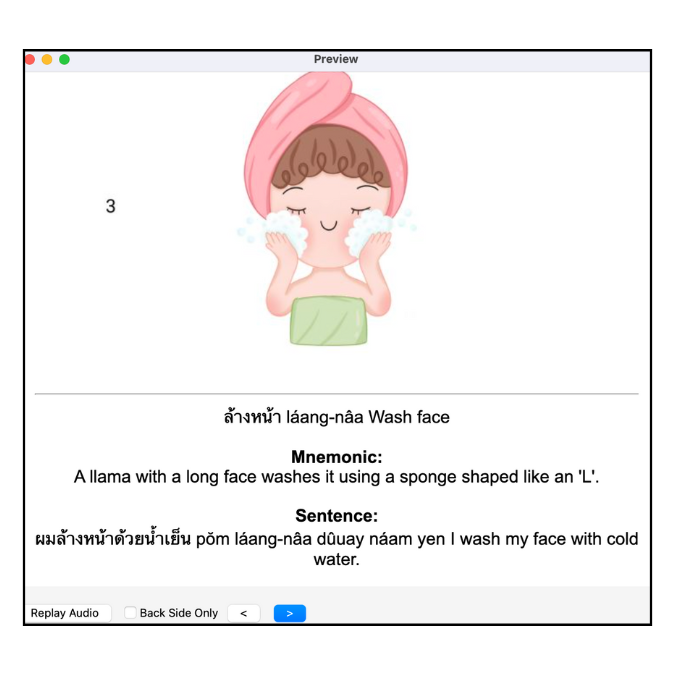
One day, I asked ChatGPT to translate a list of 625 common words into Thai. That list was based on advice from Gabriel Wyner, the author of Fluent Forever. From there, I started having ChatGPT create simple sentences using those words, and I put them into ANKI flashcards.
For nouns and verbs, I generated images in Canva and placed them on the cards. That way, I could visualize the meaning in Thai — instead of translating in my head, which is way more helpful. I also included mnemonics on the cards. Some I made up myself, and others ChatGPT generated for me.
A mnemonic is a ridiculous or emotional memory trick that helps you remember more, faster.
Then I got to work. And that vocabulary foundation has significantly improved my speaking.
🎁 Download My Thai Vocab
Starter Pack
Get the exact 625-word CSV I use every day.
👉 Click here to download
No strings attached.
Once I had a lot of the words down, I started practicing sentences tied to those words. I’d copy and paste them into Google Translate and repeat them out loud to make sure my pronunciation was solid.
ChatGPT also has a voice feature, where you can say something in your target language and it will actually respond and have a full-on conversation while generating the text on-screen at the same time. That feature alone is a game changer.
Audio Repetition with VLC
Next, I started turning the sentences into audio tracks by recording them from my laptop into my phone’s voice recorder. It was a little tedious, but totally doable.
At some point, I remembered that I’m an audio engineer, so I started pasting them into tracks in Pro Tools and creating MP3s. I loaded them onto my phone and started playing them through the VLC app, which I listen to at the gym and while I’m working.
This is extremely helpful.
Sometimes I listen passively, while other times actively repeating them out loud.
The main thing is: I only play sentences I’ve already learned. That way, it’s reinforcing known material and not just random noise.
Creating Dialogues to Memorize
Lately, I’ve been writing short conversations and translating them using ChatGPT. I treat them like mini-scripts and try to memorize them.
I usually make the conversations fun or even flirty ☺️ , so that it’s actually enjoyable to practice.
I’m also planning to translate some Thai songs that i like so I can learn how to sing them… That’s definitely going to blow some minds at the next karaoke night.😂
FINAL THOUGHTS
It’s difficult to learn a language, but I think it becomes much easier if you find ways to make it fun and stay consistent. I’ve been practicing almost every day for well over a year. I’m still far from fluent, but I’m definitely getting there.
I listen to Thai music (I love Mor Lam), and I watch Thai dramas and movies — sometimes with English subtitles, sometimes without. I’ve seen every Thai movie on Netflix.
ChatGPT is an amazing tool for language learning. There’s never been an easier time to start, so I want to encourage you to finally learn that language you’ve always wanted to.
I intend to be fluent very soon and after that, there are a few other languages I’d love to learn.
Feel free to leave a comment or share any tips you’ve found helpful in your own language journey. ✌️